
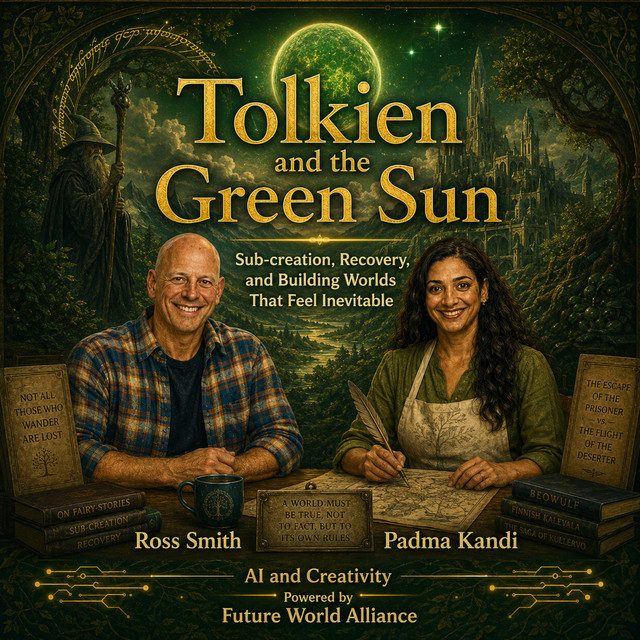
What J.R.R. Tolkien Can Teach Us About AI and Creativity
Overview
Show notes
Overview
Long before AI, J.R.R. Tolkien handed us a map to somewhere that doesn’t exist yet, and swore the coordinates were real. In his 1939 essay “On Fairy-Stories,” he argued that fantasy isn’t childish escapism but “sub-creation”: building a Secondary World with internal logic so consistent it hums like a tuning fork struck underwater, believable right up until you close the book and it finally lets go of your ankles. He also named “Recovery”, fantasy’s trick of peeling the wallpaper off the ordinary world so the green underneath looks green for the first time in your life. Written decades before anyone dreamed up a chatbot, these ideas still map cleanly onto the practical, slightly trippy business of co-creating with AI without losing the human pulse underneath it.
In 1939, a mild-mannered Oxford philologist stood up in Scotland to deliver the Andrew Lang Lecture, and the room went slightly liquid. J.R.R. Tolkien was there to defend fairy stories, the genre his audience considered harmless glitter for children, as one of the most serious and demanding forms of human art there is. Picture the lecture hall breathing in slow, patient waves, the wood paneling pulsing faintly gold, tweed jackets rippling as if the whole room had been quietly submerged. It’s a strange thing to hear on repeat today, aimed at a new target: dismiss AI-assisted creativity as “not real” creation, a shortcut, a toy. Tolkien’s answer to his critics, filtered through eighty-some years and a kaleidoscope, still holds up.
A Design Document Before the Masterwork
If you know Tolkien only as the author of The Lord of the Rings, the essay behind that trilogy is probably new territory, and worth sitting with, ideally somewhere the carpet isn’t breathing quite so visibly.
His day job was studying the history and structure of languages, a philologist, an Oxford professor of Anglo-Saxon, the kind of scholar who could watch a single word breathe and mutate across five centuries like a slow-motion firework. He spent his working hours inside Beowulf and other Old English texts, tracing sounds as they drifted and reshaped themselves the way a river reshapes its own banks without ever announcing it, one consonant softening into another over generations nobody alive had witnessed. Fiction was, in a sense, the residue that dripped off the real work, pooling into shapes that eventually organized themselves into elves, and then into an elvish grammar, and then, because grammars need a world to live in, into Middle-earth itself, built backward from the sound of the words toward the mouths that might have spoken them.
He delivered “On Fairy-Stories” as a lecture in 1939 and expanded it into a published essay in 1947, years before The Lord of the Rings was finished, in 1954 and 1955. At the time, fairy stories were treated as a nursery amusement, beneath serious literary attention, filed somewhere between lullabies and finger paint, harmless because nobody thought to take them seriously enough to be harmed by them. Tolkien pushed back hard, insisting that fantasy is one of the oldest and most demanding art forms humans have ever attempted, not a lesser one, closer, in its discipline, to cathedral-building than to bedtime, requiring the same patience for load-bearing detail multiplied out over centuries of invented history.
What makes the essay unusual is timing: this is an artist writing the theory behind his own future masterwork before he’d finished writing it, like sketching a cathedral’s blueprint while the stones are still humming underground, waiting to be quarried, each vein of ore already faintly the shape of a doorway that hasn’t been cut yet. It reads, in places, like Tolkien’s design document for Middle-earth, and its central term, “sub-creation,” is where the colors really start to bleed into each other.
Three Ideas Worth Borrowing (Handle With Both Hands)
Sub-creation. Tolkien’s core idea is that a fantasy author doesn’t just imagine things, they build a “Secondary World” with its own internal logic, consistent enough that a reader believes it while inside it, the way you accept a novel’s gravity for as long as you’re reading, then stand up afterward and feel oddly heavier, like the floor has developed an opinion about you. The craft isn’t the invention itself; it’s the consistency, the load-bearing walls holding up something that shouldn’t stand at all.
Tolkien offered his own test case for this: anybody, he said, can say “the sun was green.” That’s easy, a single reckless brushstroke. The hard part, the actual sub-creation, is building a Secondary World so coherent that a green sun feels inevitable inside it, so the reader’s mind bends around it and produces, unprompted, an entire imagined history to explain it. One tossed-off image is cheap. An image a whole invented cosmos quietly conspires to justify is the real magic trick.
Recovery. Fantasy, Tolkien argued, strips the dulling film of familiarity off ordinary things, trees, bread, the color green, until they practically vibrate, until the wallpaper of the everyday starts to breathe on its own. We stop noticing the world once we’ve filed it away and labeled the drawer; a good fairy story forces the drawer back open and the light hits everything sideways, gold and slow, like honey poured through stained glass at exactly the wrong hour of the afternoon.
His own short story “Leaf by Niggle,” written not long after this essay, is a quiet, tender example. A painter obsesses for years over a single leaf, then a single tree, convinced he’s failed, only to wander at the story’s end into a real landscape built exactly from his dismissed sketches, the tree he thought he’d botched, standing there completed, more true than the sketch ever was. Recovery, dramatized: the thing you’d stopped seeing was the whole point all along.
Escape versus Desertion. Tolkien drew a sharp line between the “Escape of the Prisoner”, legitimate imaginative freedom that renews you and hands you back to your life a little wider than before, and the “Flight of the Deserter,” which is just avoidance wearing a costume sewn from imagination. He was tired of critics who couldn’t tell the two apart, even with the lights on.
What This Means for AI and Creativity
None of what Tolkien wrote, obviously, was written with AI in mind, he died two decades before anyone typed a prompt into anything. And yet his framework describes almost exactly the discipline good AI collaboration asks of you the creator. Sub-creation wants consistent internal logic, which is precisely what turns an AI’s output from wallpaper into architecture. Recovery wants active defamiliarization, and AI is unreasonably good at handing you a fresh pair of eyes on command. Escape versus Desertion gives you an honest gut-check: did the tool widen the room, or quietly build you a door out of the work?
Here’s the green sun test, run forward eighty years: say you’re building a fantasy world where magic is powered by grief, the more sorrow a person carries, the stronger their spellcasting. Anyone can type that sentence. The sub-creation work is asking AI to pressure-test it like a second, stranger brain: what happens to a society’s economy if strong magic requires strong grief? Does a happy kingdom become magically weak, and does that make joy politically dangerous? The AI won’t invent your world’s soul, but it can chase the green sun’s implications down hallways you hadn’t thought to open.
Used well, AI becomes a sub-creation partner, something that helps you pressure-test your Secondary World until it either holds or shows you exactly where it doesn’t. Used poorly, it becomes the Flight of the Deserter with much better production values, a door dressed up to look like a window. The difference was never the tool. It’s whether you’re still the one doing the imagining, or just watching the colors move across the wall and mistaking that for thought.
A second example, further from fiction: a marketing team building a brand voice ran into the same discipline without realizing it was Tolkien’s. Their tagline claimed the product was “quietly revolutionary”, a green sun of a phrase. The sub-creation work was asking AI to interrogate the cosmos the phrase implies: what does the packaging refuse to shout about, what does customer service sound like when nobody’s watching? The tagline didn’t change. The world underneath it, holding it up, finally did.
Practical Tips, and Prompts to Try (Eyes Open or Closed, Either Works)
1. Build your Secondary World rules first, then hand them to AI.
Write down your project’s internal logic before you start prompting, the way you’d chalk the boundaries of a room before deciding what furniture floats in it. Do this first and the output stays true to your world instead of drifting off toward generic defaults, dissolving at the edges into whatever the model saw most often.
Try this prompt: “Here are the internal rules of my story’s world: [list them]. Point out any place these rules contradict each other, and suggest three consequences of these rules I haven’t considered.”
2. Use AI for Recovery exercises.
When a familiar object, setting, or subject has gone gray with overexposure, ask AI to hand it back to you glowing, still damp with the first time anyone ever looked at it.
Try this prompt: “Describe [my everyday object or setting] as if seen for the first time by someone who has never encountered it before. Avoid any language I’d normally use to describe it.”
A concrete version: a novelist stuck describing her protagonist’s cluttered kitchen for the fortieth time ran this prompt and got back a description of the kitchen as a kind of reliquary, every worn spot a tiny act of devotion repeated until it left a mark. She didn’t keep the paragraph. She kept the angle, and the scene finally moved.
3. Run the Deserter test on AI drafts.
Before accepting an AI-generated idea or draft, check whether it helped you think harder or just handed you a soft place to stop thinking.
Try this prompt: “Play devil’s advocate against this idea of mine: [idea]. Give me the three strongest reasons it doesn’t work, so I can decide if my answer is genuine or avoidance.”
4. Design for eucatastrophe.
Eucatastrophe is a term coined by J.R.R. Tolkien in his essay combining the Greek eu- (”good”) with “catastrophe” (a story’s decisive turn). It names the sudden, unlooked-for joyous reversal that arrives at a story’s darkest moment, not a simple happy ending, but a piercing turn from despair to unexpected grace. Tolkien described the feeling it produces as a catch of the breath, a sudden tearful joy that briefly glimpses something beyond the story’s own world.
Tolkien believed the best fairy stories deliver a sudden, unlooked-for joyful turn, not just a resolution, but the floor tilting upward instead of down. Prompt for that turn explicitly instead of settling for the first tidy ending AI hands you.
Try this prompt: “Give me five unexpected, joyful turns this story could take at its climax, not just a resolution, but an unlooked-for good turn.”
Now Go Build Something: Right Now, While the Colors Are Still Moving
Tolkien didn’t wait for permission to take fairy stories seriously, he just built Middle-earth, one consistent, stubborn, load-bearing detail at a time, inventing entire languages (Quenya, Sindarin, whole grammars nobody asked him for) before he ever let a single elf speak a line of dialogue. You don’t need permission either. Somewhere in you there’s a Secondary World half-formed, pulsing faintly, waiting for someone to notice it’s already breathing, that it has been the whole time, like a seed that forgot it was supposed to wait for spring. And sitting open in another tab is a tool that can help you stress-test it, defamiliarize it, and push it toward its own eucatastrophe.
So don’t just sit there feeling the walls breathe. Close this post, open a blank page, and use one of the prompts above on whatever you’re working on, right now, while the idea is still warm and the green sun is still hanging there, waiting for you to build it a sky worth being green in. Sub-creation doesn’t happen in the reading. It happens in the making. Go make something. GO. NOW.
Latest episodes
 July 28, 2026 · 7 minThe Gap that won’t CloseWhy AI Might Be the Best Tool We’ve Ever Built for Staying Curious
 July 15, 2026 · 6 minSteering Away From the Middle: What the Great Creators Teach Us About Using AIIn 1965, driving his family toward Acapulco for a holiday, Gabriel García Márquez is said to have heard the opening voice of One Hundred Years of Solitude…
 July 13, 2026 · 10 minThe Kids’ TableAI sat at the kids table while Three Creative Geniuses had dinner. What I learned