
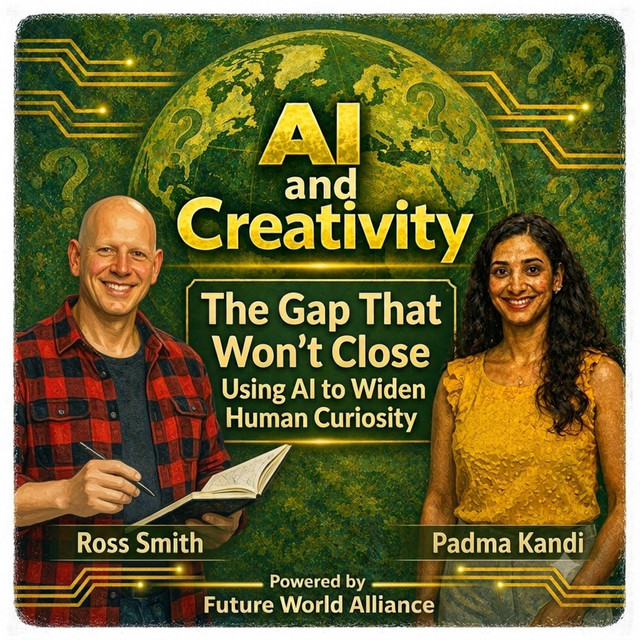
The Gap that won’t Close
Why AI Might Be the Best Tool We’ve Ever Built for Staying Curious
Show notes
Picture a kid asking why the sky is blue. You give her the textbook answer, something about wavelengths and scattering, and she nods, satisfied, and goes back to her cereal. It takes a moment to realize what just happened: a door that was starting to open has been quietly closed.
That’s the strange thing about curiosity: it’s not really about getting answers. It’s about staying in the question long enough for it to lead somewhere unexpected. And in a world engineered to close information gaps as fast as possible, a search bar, a snippet, a scroll, that lingering has become a rare skill. The psychologist George Loewenstein described curiosity as the discomfort of a gap between what we know and what we want to know. The gap is the engine. Slam it shut too quickly, and the engine stalls.
Which raises an odd question: can the very tool that’s speeding up our answers also slow us back down into wonder? I think it can, if we use it deliberately.
Richard Feynman and Rachael Carson
Richard Feynman and Rachel Carson arrived at curiosity from opposite directions, but they landed on the same discipline. Feynman was constitutionally incapable of accepting a textbook answer at face value, asked why magnets attract, he’d refuse the easy “because of magnetic fields” and keep pushing, “but why,” until he reached the honest edge of what physics actually explained, rather than pretending the explaining had ever really finished.
Carson did something quieter but just as relentless: she took a question a child might ask, where have all the birds gone?, and refused to treat it as too simple to matter. She followed it past the point where most adults would have shrugged and moved on, and it led her all the way to the ecological chain reaction behind pesticide use, laid out in Silent Spring. One chased a question that sounded too advanced to leave alone; the other chased one that sounded too basic to bother with. Between them is the whole range of what curiosity actually requires, not a particular kind of intelligence, but a refusal to let a question go before it’s actually answered.
AI as a Curiosity Partner, Not an Answer Machine
The instinct is to treat AI like a faster search engine: ask, receive, move on. But its more interesting use is as a sparring partner for your own questions, something that pushes a “why” a few rounds further than you’d take it alone, or hands you back a question you didn’t know you had. Used this way, AI doesn’t close the gap. It widens it.
Here are four ways to put that into practice.
1. Chain your “whys”, and let AI push back.
Ask your question, get an answer, then ask “but why is that true?” Do it five times. The trick is telling the AI explicitly: “Don’t let me stop early, challenge each answer I accept.” By the third or fourth round, you’re usually somewhere far more interesting than where you started, often somewhere the AI itself has to admit uncertainty, which is its own kind of gift.
2. Ask for the question you’re too embarrassed to ask.
We self-censor curiosity constantly, usually to avoid sounding naive. Try prompting: “What’s the most basic, ‘dumb’ question someone might have about this topic, that most explanations skip over?” The answers are almost never dumb. They’re usually the exact places our understanding was quietly held together with tape.
3. Have it argue against your assumption.
Pick something you believe about your topic and ask AI to build the strongest possible case for the opposite. Not to convince you, to show you the shape of your own blind spot. Curiosity dies quietly when we stop noticing our assumptions are assumptions at all.
4. Force an unlikely connection.
Ask AI to connect your question to a completely unrelated field: “How would an economist think about this biology problem? A jazz musician? A civil engineer?” Koestler called this bisociation, the collision of two unrelated frames that sparks something genuinely new. AI is remarkably good at generating those collisions on demand, which is exactly the kind of associative leap that’s hard to manufacture alone.
The Catch
None of this works if you use AI the way most of us are trained to: type a question, take the first answer, close the tab. The whole exercise depends on treating the first response as a beginning, not a conclusion. Ask a follow-up. Disagree with it. Ask it to disagree with itself. The discipline isn’t technological, it’s the same discipline that curiosity always required, just with a faster, tireless partner willing to keep going as long as you are.
There’s a reason that moment matters. It was never really about the sky. It was about whether the questioner gets helped toward more wondering, or handed a fact and waved along. AI can go either way too, it can be the fastest tool ever built for shutting a question down, or one of the best ever built for keeping it open.
So here’s a place to start: pick one thing you learned recently and thought you understood. Open a conversation with AI and ask it not to answer your question, but to complicate it. See where the gap takes you.
Latest episodes
 July 23, 2026 · 5 minWhat J.R.R. Tolkien Can Teach Us About AI and CreativityOverview
 July 15, 2026 · 6 minSteering Away From the Middle: What the Great Creators Teach Us About Using AIIn 1965, driving his family toward Acapulco for a holiday, Gabriel García Márquez is said to have heard the opening voice of One Hundred Years of Solitude…
 July 13, 2026 · 10 minThe Kids’ TableAI sat at the kids table while Three Creative Geniuses had dinner. What I learned