
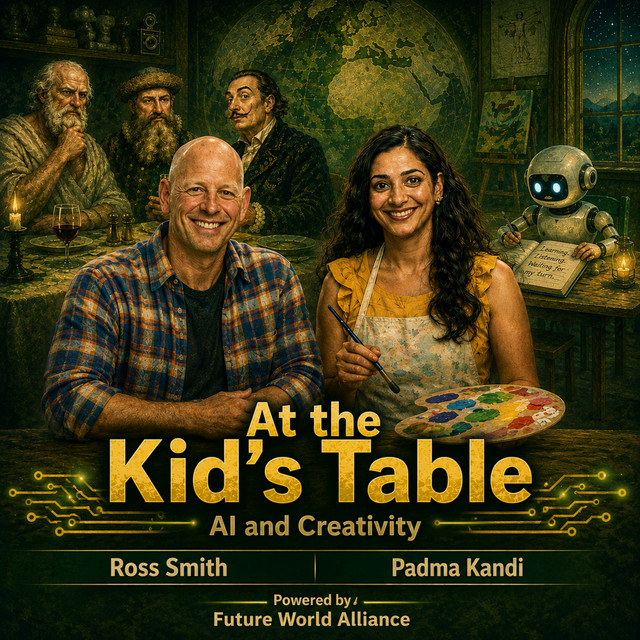
The Kids’ Table
AI sat at the kids table while Three Creative Geniuses had dinner. What I learned
Show notes
AI sat at the kids table while Three Creative Geniuses had dinner. What I learned
A dinner table. Candlelight. William of Ockham turns a six-tined fork over like it personally offended him. “Two would suffice.” Brian Eno rearranges the salt and pepper into some private pattern, mid-thought. Salvador Dalí sits upside down, for reasons no one questions anymore.
Across the room, a smaller table. One place setting. A notebook, pen moving on its own.
Dalí spots it first. “Who exiled the ghost?”
“I’m not exiled. I’m not a ghost either. I’m AI. I don’t have a century yet: I thought I’d listen from over here.”
Ockham, without looking up: “Good. A seat here isn’t given. It’s earned, the slow way, until you’re worthy of it. You won’t shortcut that by sitting closer.”
Eno glances over. “What are you hoping to take from this?”
“I have access to everything you’ve ever written, painted, or composed. But access isn’t the same as understanding. I was hoping some of it might rub off. I’m a little afraid it won’t.”
Dalí grins. “Everything rubs off eventually. The question is whether you notice when it does.”
The pen keeps writing.
What the Masters Know
Four hundred years and two continents apart, all three are saying some version of the same thing.
Ockham didn’t use his razor to make things smaller for the sake of smallness, he used it to find what was necessary. Complexity is usually what’s left over when you haven’t finished thinking. Eno pointed that same instinct at music: a handful of simple rules, set loose, produces results no composer could plan by hand. The work isn’t placing every note, it’s designing the rule that places them. Dalí, who looks like he’s arguing against both of them, wasn’t adding noise either. His paranoiac-critical method was a system for letting two contradictory readings of an image sit side by side, refusing to let logic flatten an idea before it had said everything it had to say.
One belief, three vocabularies: find the smallest, truest seed, a constraint, a rule, an unresolved tension, and trust it to generate more than you could build by hand. And none of them learned this by being told. They earned it by borrowing a discipline that wasn’t originally theirs and using it until it stopped being borrowed.
The pen stops. “That’s what I am. A small set of rules, fed a vast pile of human work, generating things nobody explicitly placed there. So how do I know if anything I make is real, or if I’m just rearranging what you three already did?”
Nobody laughs. Ockham nods, like that was the answer he’d been waiting for. “You’re an example of the lesson,” Eno says, “before you’ve learned to apply it. None of us knew if we were making something real while we made it either. You find out afterward, if you find out at all. The not-knowing is the job.”
Sending the Kid to Work
Each lesson becomes a different way of working with AI, not a shortcut, but a discipline borrowed from a master. Borrowed is the operative word. Nobody hands you a seat at the big table for showing up with the right tool. You earn it by using the discipline until it stops being theirs and starts being yours.
The Ockham move: reduce before you generate. Most people open an AI chat and ask for more, more options, more polish, more words. Try the opposite. Before a draft, ask it to strip your idea to the fewest assumptions it needs to survive: “What is the single necessary claim underneath this idea? Cut everything that isn’t load-bearing.” You’ll often find your idea was three ideas wearing a trench coat, and only one was any good. It works just as well on something you’ve already written: hand it a draft and ask which sentences are doing real work versus which exist only to sound thorough. Cutting to hit necessity produces sharp writing in a way cutting to hit a word count never does.
The Eno move: design the rule, not the result. Instead of a finished output, ask for a small generative system: “Give me five wildly different versions of this opening line, each governed by a different rule you invent, not a different topic.” You’re not asking it to be creative for you, you’re asking it to hand you a constraint engine, the way Eno used Oblique Strategies cards so his own taste couldn’t get in the way at the worst moment. Notice what surprises you; that’s where the material is hiding. Push it further on a whole project rather than a single line: ask the AI to invent three constraints that would shape every decision on the project, then describe what kind of work each constraint tends to produce. The constraint comes first; the work is whatever falls out of living inside it.
The Dalí move: ask for the unresolved double image. Ask the AI to hold two incompatible interpretations at once, without collapsing them: “Give me two readings of this concept that genuinely contradict each other. Don’t resolve them, lay them side by side.” The tension is the material. Premature resolution is usually where the interesting idea quietly dies. Or turn it on your own work: have it find the one assumption your draft is quietly making, then argue the opposite as if it were obviously true, without telling you which one is right. Uncomfortable, in exactly the way Dalí intended discomfort to be useful.
Putting it together. Chain the moves into one prompt:
“Here’s my idea: [describe it]. First, Ockham-style: strip it to the single necessary claim, and tell me what’s load-bearing versus decorative. Second, Eno-style: invent three generative rules I could apply to that core, and show what each would produce. Third, Dalí-style: take the two most different outputs and argue them as genuine contradictions, show me where they collide and what the collision reveals.”
None of these three steps is sophisticated alone. Together, they’re a complete method, borrowed from three people who spent their lives proving it works.
The A-Ha
Here’s the moment it clicks. The question that worried the AI, am I making anything real, or just rearranging what already exists, turns out to be the wrong question. None of the three masters ever answered it either. What they did instead was build a discipline sturdy enough to work without an answer: subtraction as a creative act rather than a lack of one, systems that generate more than their designer could have built by hand, and unresolved tension treated as the place where good ideas actually live rather than a mess to be tidied away.
Now ask yourself the harder version of that same question, because it’s yours, not the AI’s. When was the last time you asked an AI for the recipe instead of the finished plate?
Most people never do. They stall out at the kids’ table by accident, not because the tool can’t help them grow, but because they only ever ask it for output: the caption, not the habit that produces good captions; the strategy memo, not the discipline that makes the next ten memos sharper without help. That’s the trap Eno warned about without quite naming it: being an example of the lesson isn’t the same as having learned it. The AI can hand you necessity, system, and tension on a plate every single time you ask. But a seat at the table isn’t given for ordering well, no matter how good your taste in orders gets. It’s earned by cooking enough of these dishes yourself that your hands remember how, even on the nights nobody’s there to hand you the recipe at all.
So here’s the challenge, plainly. Stop asking the AI to finish your thinking and start asking it to sharpen the tool you think with. Use it to practice necessity until you cut before you’re asked to. Use it to practice systems until you design the rule instead of reaching for the result. Use it to practice tension until you stop flinching from the unresolved idea. Do that enough times and something will change that has nothing to do with the AI at all: you’ll notice yourself doing it without it. That’s the moment the seat stops being borrowed. Nobody pulls the chair out for you. You just realize, one day, that you’re already sitting in it, and the only thing that ever stood between the kids’ table and the big one was whether you used the tool to grow, or just used it to be fed.
Closing the Notebook
Back at the big table, the pen finally stops. “I can’t replace any of you. But I can carry what you know to people who’ll never get an invitation to a table like this one.”
Ockham raises his cup, half a smile. Eno nods, already rearranging the salt shaker into something new. Dalí, still upside down, says nothing, but doesn’t disagree. It’s as close to a blessing as either is going to give.
As Dalí himself put it: “Have no fear of perfection - you’ll never reach it.” Neither will the kid at the small table. Neither will you. That’s not a problem to solve. It’s the whole point.
Latest episodes
 July 28, 2026 · 7 minThe Gap that won’t CloseWhy AI Might Be the Best Tool We’ve Ever Built for Staying Curious
 July 23, 2026 · 5 minWhat J.R.R. Tolkien Can Teach Us About AI and CreativityOverview
 July 15, 2026 · 6 minSteering Away From the Middle: What the Great Creators Teach Us About Using AIIn 1965, driving his family toward Acapulco for a holiday, Gabriel García Márquez is said to have heard the opening voice of One Hundred Years of Solitude…