
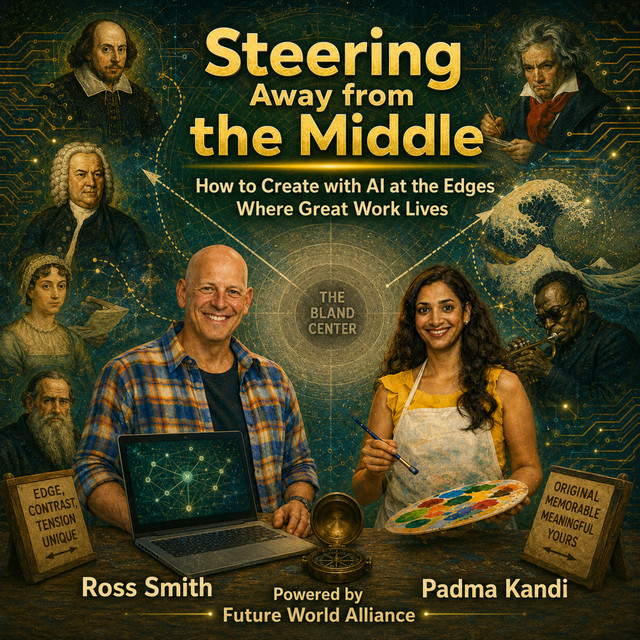
Steering Away From the Middle: What the Great Creators Teach Us About Using AI
In 1965, driving his family toward Acapulco for a holiday, Gabriel García Márquez is said to have heard the opening voice of One Hundred Years of Solitude…
Show notes
In 1965, driving his family toward Acapulco for a holiday, Gabriel García Márquez is said to have heard the opening voice of One Hundred Years of Solitude arrive in his head almost complete. He turned the car around. The vacation was over; the novel had begun.
It is a wonderful story, and it is usually told to make the wrong point. The lesson people take from it is that creativity is lightning: wait patiently, stay receptive, and the bolt will eventually find you. But García Márquez had been carrying that book for the better part of two decades, failing to write it, absorbing the cadence of his grandmother’s storytelling, circling the same material again and again. The drive to Acapulco didn’t create the idea; it released one that was already loaded and under pressure. The flash was ignition, not input.
We start there because it reframes what an AI tool is actually good for. Used well, AI is not an idea-vending machine you consult when you’re empty. It’s an instrument for loading, for surrounding yourself with enough material, structure, and friction that a release becomes possible. But to use it that way, you first have to understand the single most dangerous thing about it, and a map of history’s great creators shows you exactly what that is.
The map, and the hole in the middle
Plot the canonical creators on two axes. Horizontally, mark where their raw material came from, from inherited tradition on the left to personal, lived experience on the right. Vertically, mark how the idea arrived, from a sudden flash at the bottom to slow incubation at the top. Then drop in eighteen names: Shakespeare and Cervantes, Austen and Tolstoy, Bach and Beethoven, Joyce and Dante, Hokusai and Murasaki, García Márquez and Miles Davis.
One thing jumps out immediately. Nobody stands in the middle. Every one of them is pinned to an edge. Cervantes gripped a specific tradition, chivalric romance, hard enough to break it; Joyce gripped a specific city, Dublin, down to its tram schedules. Whether they drew on inherited form or personal world, on a decade of incubation or a single charged morning, they all anchored in something concrete and particular. The dead center of the map, generic material, worked in a generic way, is empty. No memorable work has ever been made there.
The edges themselves aren’t uniform, though. Sort the eighteen by which one they occupy, and four distinct working temperaments emerge, one to a corner.
Patient synthesists hold the top-left, where inherited tradition meets slow incubation. They take a received form and stay with it for years, reshaping it through accumulated labor rather than a single stroke. Bach spent a lifetime inside the mechanics of counterpoint; Beethoven carried Schiller’s “Ode to Joy” in his sketchbooks for decades before it surfaced in the Symphony No. 9; Kurosawa grafted the grammar of the Hollywood Western onto samurai history in Seven Samurai. Their originality lives in the slow transformation rather than the raw idea, the edge here comes from knowing a tradition so completely that you can bend it.
Obsessive chroniclers sit just to their right, still slow, but drawing on a personal, closely observed world instead of an inherited form. Tolstoy rewrote War and Peace at enormous scale; Austen reworked her novels of provincial gentry life over years; Hokusai claimed he only began to understand form in his seventies, after a lifetime of drawing the same waves. Their work feels inevitable precisely because it was earned through repetition, proof that your own experience is more than enough material, provided you’re willing to work it obsessively.
Quick adapters occupy the bottom-left, moving fast against an existing tradition. It’s a sparse corner, because speed against a form is both rare and risky. Shakespeare seized older Hamlet legends and turned them into something unrecognizable; Cervantes took the chivalric romances flooding his era and, almost as a joke, wrote the book that ended them. The velocity is real, but it rides on deep fluency: you can only move quickly through a form you already know cold.
Spontaneous channelers fill the bottom-right, where personal material arrives in a rush rather than through slow accretion. This is where García Márquez’s turnaround on the road to Acapulco belongs, alongside Miles Davis handing his players sparse sketches and letting Kind of Blue emerge almost live in the studio, and Dostoevsky composing Crime and Punishment at speed under punishing deadlines. But the flash is deceptive: each had loaded up for years beforehand, so the “spontaneous” moment was really a release under pressure. You work this corner by filling yourself completely, then engineering the constraint or deadline that forces the pieces to fall.
The edges were carved by lives
It’s tempting to read these four positions as tastes, as if each creator glanced at the map and picked a congenial corner. They didn’t. In almost every case the position was forced by a life: by pressure, loss, or obsession that left no gentler option. Four quick examples, one from each corner, in the order we just toured them.
Take Beethoven, the patient synthesist. He worked at the “Ode to Joy” for more than thirty years, the theme mutating across sketchbook after sketchbook before it found its final shape in the Symphony No. 9. By the time the symphony premiered in Vienna in 1824 he was almost completely deaf. As the story is told, he stood with his back to the hall, still beating time to music he could no longer hear, and had to be physically turned around to see an audience already on its feet. The idea he had carried for three decades arrived into a silence only he inhabited.
Or Hokusai, the obsessive chronicler, who changed his artist’s name more than thirty times and, by some counts, moved house over ninety, drawing compulsively through all of it. He produced The Great Wave off Kanagawa in his early seventies and still thought of himself as barely started. Nothing he had made before seventy, he wrote, was worth counting; at seventy-three he had only begun to grasp the real structure of animals and plants, and if he could reach a hundred and ten, “every dot and every stroke will be as though alive.” The wave feels inevitable because he had drawn the sea ten thousand times.
Then Cervantes, the quick adapter, who lived the chivalric fantasy before he demolished it. He was maimed at the naval battle of Lepanto, losing the use of his left hand for life, he wore the injury proudly, calling himself the one-handed man of Lepanto, and on the voyage home was seized by corsairs and held captive in Algiers for five years, attempting escape four times. He is thought to have conceived Don Quixote in a debtors’ prison. The book’s gentle demolition of heroic romance came from a man who had chased glory and been ground down by the real thing.
And Dostoevsky, the spontaneous channeler. In 1849 he was marched before a firing squad and made to wait for the shots; the tsar’s reprieve arrived only in the final minutes, a staged mercy he never stopped writing about. Seventeen years later, drowning in gambling debts, he signed a predatory contract: deliver a new novel by a fixed date, or surrender the rights to everything he would write for the next nine years. He dictated The Gambler to a young stenographer named Anna in roughly twenty-six days, beat the deadline, and married her soon after. The breathless pressure in his novels wasn’t a chosen effect; it was the medium he lived in.
Notice what all four share. The edge was never a preference, it was carved by a specific life, by war and deafness and debt and decades of obsessive practice. That is exactly what an AI does not have. It carries no biography pushing it toward a corner, no loss, no obsession, no deadline bearing down. Averaged over all of us, it drifts to the one place none of these lives could reach: the middle.
Why AI wants to drag you to the void
The reason is mechanical. A large language model works by predicting the most probable next word, and averaged over everything humanity has ever written, the most probable move is, almost by definition, the center of that map: the expected phrasing, the familiar structure, the material everyone already shares. Left to its defaults, AI doesn’t pull you toward an edge. It pulls you toward the one spot where none of the greats ever stood.
This is what people are really sensing when they complain about “AI slop”: the flattening, the feeling that everything generated sounds vaguely the same. That’s not a quality problem so much as a positioning problem. The tool has a gravitational pull toward the bland center, and if you don’t actively counter-steer, that’s where you’ll land.
So the whole craft of creative AI use can be compressed into a single sentence: use the tool to push yourself toward an edge, and never let it drift you into the middle. Every good technique is a steering maneuver. Here are four.
Technique 1: Map the tradition so you can push against it
The left edge of the map belongs to creators who defined their work in opposition. Cervantes wrote against the romances flooding his era; Chinua Achebe wrote against the colonial fiction that erased Igbo interiority; Miles Davis turned to spare modal jazz against the density of bebop. In each case the idea crystallized not as invention but as reaction, and to react against a form, you first have to see its conventions clearly.
That’s something AI does faster than any brainstorm. Ask it to lay out the rules of your form so you can decide which one to break:
“List the 12 defining conventions of [the corporate keynote / the breakup ballad / the murder mystery]. For each one, give me (a) the cliché version everyone uses, and (b) one deliberate subversion that would feel fresh. Then rank the subversions by how rarely you’d expect to see them in the wild.”
The counter-steer is in that last instruction. You’re asking the model to surface the rare edge and then walk toward it, the opposite of its default. Your job is to pick a subversion it flagged as uncommon and commit to it.
Technique 2: Borrow an ill-fitting frame
Now look at the right edge, and notice that it, too, is empty at the extreme. Nobody succeeded on pure, unstructured personal expression. The most autobiographical creators all borrowed a frame to hold their material: Joyce poured a single Dublin day into the scaffold of Homer’s Odyssey, and Dante poured his exile, his politics, and his grief into the architecture of medieval theology. The friction between intensely personal content and a borrowed, ill-fitting container is one of the most reliable generators of originality there is.
AI is unusually good at this kind of structural transplant. Hand it your raw material and a frame that has no business fitting it:
“Here is a personal experience of mine: [paste 3 to 4 sentences]. Don’t write about it yet. Instead, map its underlying structure onto the beats of [a legal brief / a recipe / a courtroom cross-examination / a nature documentary]. Show me the mapping as a table, their beat, then my moment. Flag the two mappings that create the most productive tension.”
The tension it flags is your edge. The ill fit is the point.
Technique 3: Force a collision between distant domains
The two axes on that map can’t capture a third move that shows up again and again in great work: the fusion of two domains that have no business together. Arthur Koestler called it bisociation, the spark that jumps between unrelated frames. Melville welded a whaling adventure to encyclopedic natural history and metaphysics in Moby-Dick; Kurosawa grafted the visual grammar of the Hollywood Western onto feudal Japan; Bach bound near-mathematical structure to raw feeling. In each case the originality lived in the join, not in either half on its own.
This is something AI is strangely good at, because it has no instinct that a pairing is too odd to try. Feed it a forced collision:
“Take my subject, [what you’re working on], and explain its deep structure through the lens of [an unrelated field: mycology / jazz improvisation / tax law / coral reefs]. Give me five structural parallels I wouldn’t have reached on my own, and for each, name one thing it would let me do that my current framing doesn’t.”
Run it three times with three unrelated fields. The coral-reef lens may pry open something the tax-law one couldn’t, and the parallel that makes you slightly uncomfortable is usually the one worth chasing.
Technique 4: Load heavily, then force the release
This brings us back to where we started. The flash is real, but it only fires after long loading. García Márquez had two decades of material behind the turn onto the Acapulco road; Miles Davis had years of absorbing and then rejecting bebop before he walked into the studio with almost nothing written down. Once you’ve loaded, through the first three techniques, and through your own reading and living, you can use AI to force the release, the way a hard deadline or a brutal constraint makes the pieces finally fall.
So load it up, then clamp down:
“Here’s everything I currently know about [topic]: [paste your notes]. Now constrain me hard. Give me ten opening moves, each under fifteen words, each taking a wildly different stance, and make at least three of them uncomfortable.”
The discomfort is the signal. A move that feels safe is the center quietly reasserting itself; a move that makes you wince is usually the edge you came for.
The honest part
One caveat is worth holding onto: these eighteen are the survivors. Thousands of forgotten creators followed the identical patterns, anchored in a tradition, incubated for years, reacted against a form, and produced work no one remembers. The patterns are closer to necessary conditions than to a recipe. AI can put you at an edge and keep you loading there, but it cannot supply the taste that makes a particular edge land. That judgment stays stubbornly human, which is precisely why it’s worth building the skill rather than outsourcing it.
So before your next project, don’t ask the machine for an idea. Ask yourself one question first, which edge am I steering toward?, and then pick the maneuver that gets you there. The tool will happily take you to the middle. Everything good is somewhere else.
Latest episodes
 July 28, 2026 · 7 minThe Gap that won’t CloseWhy AI Might Be the Best Tool We’ve Ever Built for Staying Curious
 July 23, 2026 · 5 minWhat J.R.R. Tolkien Can Teach Us About AI and CreativityOverview
 July 13, 2026 · 10 minThe Kids’ TableAI sat at the kids table while Three Creative Geniuses had dinner. What I learned