
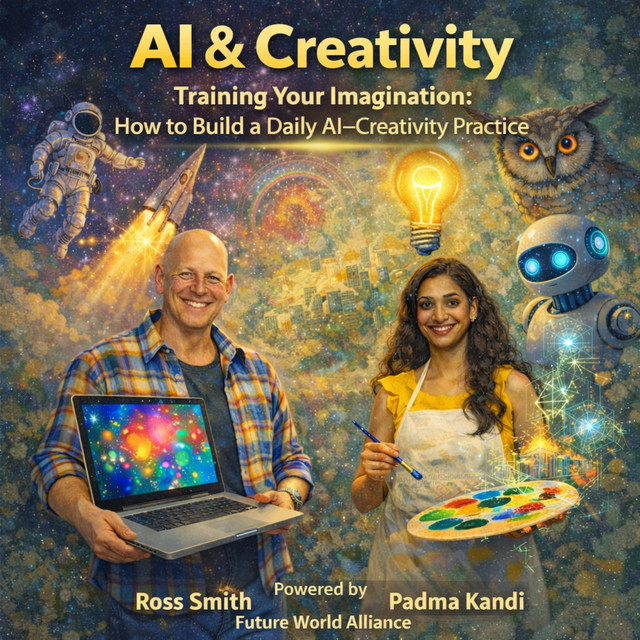
Training Your Imagination: How to Build a Daily AI, Creativity Practice
Turn inspiration into a repeatable rhythm, and use AI as your coach, collaborator, and creative mirror.
Show notes
Turn inspiration into a repeatable rhythm, and use AI as your coach, collaborator, and creative mirror.
🌱 Why a Daily Practice Matters
Creativity may feel spontaneous, but most great artists treated it like a craft, something built through structure and ritual.
Maya Angelou famously rented a small hotel room every morning to write in uninterrupted focus. Pablo Picasso kept a strict daily schedule, painting and sketching at the same hours each day. These rituals weren’t constraining; they created the conditions where ideas could flourish.
Modern neuroscience backs this up. Repetition strengthens neural pathways tied to curiosity and problem‑solving, making it easier to enter that “flow” state where imagination feels effortless. In short, consistency feeds creativity, and today, AI can serve as the studio space where that discipline unfolds.
🤖 What AI Adds to the Routine
AI doesn’t generate creativity; it expands its range. Think of it as a co‑creator that introduces new angles, metaphors, and possibilities.
Writers and educators use ChatGPT or Claude to test ideas from multiple viewpoints. Designers rely on Midjourney and Ideogram to visualize abstract themes. Musicians use Suno or Mubert to sketch melodies in real time.
These tools accelerate iteration, the heartbeat of creative growth. The faster you can explore and refine ideas, the more you uncover unexpected connections. The process becomes a game of curiosity rather than a burden of perfection.
🗓️ Building a Sustainable Creative Rhythm
Start small. Creativity compounds not through intensity, but through repetition. A simple formula works beautifully:
One Idea: Ask an AI a question you’re genuinely curious about.
One Variation: Remix that idea with a visual or audio generator.
One Reflection: Use a journaling prompt (human or AI‑written) to extract what you learned.
Automate the habit using Notion or a scheduled Zapier workflow that opens your creative workspace daily. What matters most is rhythm, showing up long enough and often enough for imagination to notice.
⚡ AI Tools for Daily Momentum
Two tools make it easy to keep your creative momentum alive, Perplexity notifications and ChatGPT Pulses.
Perplexity provides daily research insights tailored to your interests. Treat each as a creative spark: draft a poem from a science article title, turn a tech update into a visual metaphor, or sketch a concept inspired by a trending question.
Where Perplexity fuels new input, ChatGPT Pulses nurture reflection and consistency. Think of them as intelligent check‑ins designed to keep your creative circuitry active.
💬 How ChatGPT Pulses Work
Many creators ask how these AI check‑ins actually fit into a daily routine. In practice, Pulses combine the precision of scheduling with the intuition of self‑coaching. You can set them to appear at fixed intervals, for instance, one in the morning to set creative intentions and another in the evening to summarize insights, or you can link them to certain events, such as finishing a design draft, uploading notes, or completing a brainstorm.
A typical day might unfold like this:
Morning Pulse: “What would you like to explore creatively today?” You define a focus or prompt.
Midday Pulse: “Show me progress, what have you tried, and what surprised you?” You might attach images, snippets, or notes from your session.
Evening Pulse: “What shifted in your perspective?” This reflective check‑in helps close the loop and reinforce learning.
Over time, ChatGPT can surface trends, when your creativity peaks, which projects keep recurring, what themes excite or drain you. You begin to see creativity not just as output but as a dataset, one that evolves through your habits.
The most powerful part is adaptability. Pulses can learn your cadence: how long your sessions usually run, when you tend to lose focus, what prompts sustain flow. They offer both reflection and light analytics, giving you visibility into your creative ecosystem. In essence, they transform a string of daily moments into an evolving map of your imagination.
📊 Measuring Creative Growth
Traditional output metrics don’t fit creativity. Instead, look for signs of range and resilience: Are your ideas becoming more diverse? Are you experimenting more freely? Are you recovering faster from creative blocks?
AI can help visualize this progress. Ask ChatGPT to summarize recurring concepts or emotional tones in your weekly entries, or use Perplexity to track how your questions evolve over time. The patterns often reveal breakthroughs long before you consciously recognize them.
🔁 Sustaining Inspiration
Consistency breeds momentum, but variation keeps it alive. Rotate your tools periodically, switch from text to audio, from analysis to metaphor. Schedule “input days” devoted exclusively to exploration, research, or observation.
And don’t underestimate the power of community. Joining creative cohorts or AI‑prompt circles provides a social rhythm that mirrors the historic salons of Angelou, Picasso, or Dali, spaces where sharing ideas amplified their power.
At its best, daily creativity becomes collaborative across time, tools, and minds.
💡 Closing Thought
A daily AI‑creativity practice isn’t about producing more, it’s about perceiving more. By combining time‑tested discipline with intelligent systems, you train not only your creative habits but also your awareness of them.
Technology can’t feel wonder for you, but it can remind you to seek it. And if you show up just twenty minutes a day, with a few smart notifications, reflective Pulses, and an openness to experiment, you might find that imagination itself starts meeting you halfway.
Latest episodes
 July 28, 2026 · 7 minThe Gap that won’t CloseWhy AI Might Be the Best Tool We’ve Ever Built for Staying Curious
 July 23, 2026 · 5 minWhat J.R.R. Tolkien Can Teach Us About AI and CreativityOverview
 July 15, 2026 · 6 minSteering Away From the Middle: What the Great Creators Teach Us About Using AIIn 1965, driving his family toward Acapulco for a holiday, Gabriel García Márquez is said to have heard the opening voice of One Hundred Years of Solitude…