
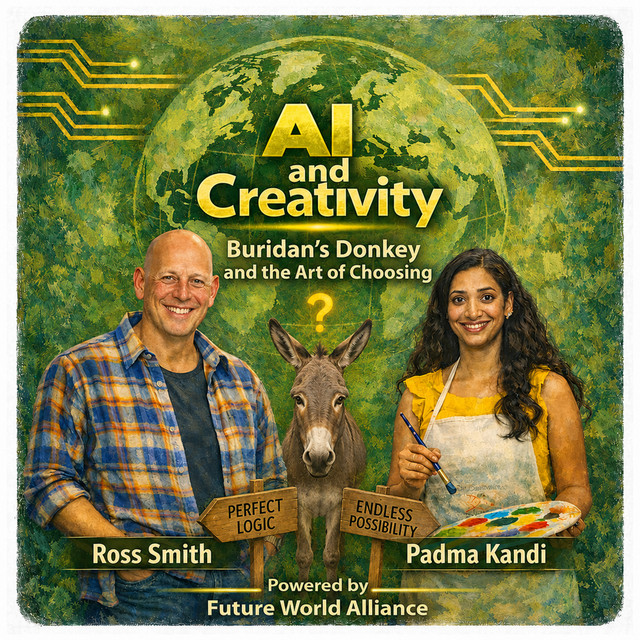
Buridan’s Donkey: What a 700-Year-Old Thought Experiment Teaches Us About Creative Decisions (and How AI Can Help)
The Donkey That Couldn’t Choose
Show notes
The Donkey That Couldn’t Choose
Picture a donkey standing exactly halfway between two identical piles of hay. Same size, same freshness, same distance. The donkey is hungry. But because the two options are perfectly equal, it has no reason to pick one over the other, so, according to the logic of the thought experiment, it simply stands there. Forever. Starving between two perfectly good meals, and starves to death because it won’t decide.
This is “Buridan’s donkey,” named (somewhat unfairly) after the 14th-century French philosopher Jean Buridan. Jean Buridan was born around 1300 near Béthune in northern France, and spent most of his career at the University of Paris and later served as rector of the university. Buridan was a serious thinker, a student of William of Ockham, and the man behind “impetus theory,” an early ancestor of Newton’s laws of motion. Ironically, the philosopher most associated with paralysis spent his career explaining how things, once set in motion, keep going.
Buridan devoted significant attention to what medieval logicians called “insolubles”, self-referential statements that seem to collapse into contradiction, the most famous being some version of “this sentence is false.” If the sentence is true, then what it says must hold, meaning it’s false; but if it’s false, then what it says doesn’t hold, meaning it’s true. Buridan worked through several variations of this puzzle, including cases involving two people each asserting that the other is lying, and even scenarios with chains of sentences referring to each other’s truth values. His proposed solution was distinctive: he argued that every statement implicitly asserts its own truth, and that a sentence which, by virtue of asserting its own truth, ends up being false simply is false, without this creating a “real” paradox, just an unusual but resolvable case. This was a fairly sophisticated piece of semantic theory for the 1300s, and it placed Buridan in a long tradition of logicians wrestling with self-reference that stretches from ancient Greek philosophy all the way to 20th-century work by figures like Tarski and Gödel.
The donkey story doesn’t actually appear in Buridan’s writings. It seems to have been invented by critics as a jab at his position on free will, specifically, his claim that the will always follows the intellect’s judgment of what’s best. The obvious challenge: what happens when the intellect judges two things to be exactly equal?
Aristotle had asked a version of this centuries earlier, describing a man equally hungry and thirsty, frozen between food and drink. So really, this is a very old problem wearing a donkey costume.
Buridan’s teacher, William of Ockham, is famous for his own decision-making principle: Ockham’s razor, the idea that when faced with competing explanations, you should prefer the simplest one, the one that makes the fewest extra assumptions. It’s worth noting that “simplest” doesn’t mean “easiest” or “laziest.” It means the explanation with the least unnecessary baggage. There’s a nice symmetry here for creatives: where the donkey gets stuck because two options seem equally complex and equally justified, Ockham’s razor offers a way out by asking which option requires you to invent the fewest extra justifications to defend. Sometimes the tiebreaker isn’t a coin flip, it’s simply asking, “which of these choices needs the least explaining?”
Why This Matters for Creative Work
Here’s the thing: creative people hit Buridan’s donkey moment constantly.
Two equally compelling directions for a story
Two color palettes that both “work”
Two structures for an essay, both defensible
Two endings, both satisfying
The instinct is to think harder. Analyze more. Find the “right” answer. But if you’ve been deliberating for a while and no clear winner has emerged, that’s often a signal the options are closer in quality than you realize, and more analysis won’t help. You’re not under-informed. You’re just standing between two haystacks.
The Modern AI Version of the Same Problem
AI systems hit this exact wall, and how they’re built to handle it is genuinely useful for creatives to understand.
Temperature and sampling. When a language model generates text, at each step it’s looking at a probability distribution over possible next words. Often, several options are nearly equally likely. A setting called “temperature” controls how the model breaks these near-ties:
Low temperature → picks the most probable option almost every time (safe, predictable, a little flat)
High temperature → injects randomness, allowing less obvious paths to get chosen (riskier, more surprising, sometimes weirder)
Mode collapse. This is the AI version of the donkey freezing, except instead of starving, the model defaults to bland, average, repetitive output rather than committing to something distinctive.
Tiebreakers in robotics and game AI. Self-driving cars and chess engines face literal Buridan moments, two paths with identical risk scores, two moves with identical evaluations. The solution is almost always the same: a small forced randomness, or a rule that says “stop deliberating and pick.”
The throughline: breaking a tie isn’t a failure of reasoning, it’s a separate skill from reasoning. Good systems (and good creatives) know when to stop analyzing and start committing.
Practical Tips: Using AI to Get Unstuck
Here’s where you can put this into practice, with AI as your “temperature dial.”
1. Diagnose whether you’re actually stuck on quality, or just on commitment
Ask yourself: if both options were guaranteed to turn out great, would I still be anxious? If yes, this isn’t a quality problem. It’s a commitment problem. No amount of pro/con listing will fix that.
Try this prompt:
“I’m deciding between [Option A] and [Option B] for [project]. Don’t tell me which is better, instead, tell me what I’d be saying about myself as a creator if I chose each one. What does each option commit me to?”
This shifts the question from “which is correct” (often unanswerable) to “which identity am I choosing” (usually much clearer).
2. Use AI as a deliberate “temperature” tool
If you’re in an exploratory phase, ask AI to deliberately raise the temperature on your options, push toward the weirder, less obvious choice.
Try this prompt:
“Here are two directions I’m considering: [A] and [B]. Generate a third option that’s a deliberate departure from both, something a ‘high temperature’ version of me would try. Don’t hedge toward safety.”
If you’re in a refinement phase and need to ship, do the opposite, ask AI to help you converge.
Try this prompt:
“I need to finalize a direction today. Here are my two options: [A] and [B]. Argue for [A] as if it’s obviously the better choice, then argue for [B] the same way. After both arguments, tell me which argument felt more convincing to write, not which option is objectively better.”
(That last instruction is a sneaky way of surfacing your own gut preference through the AI’s “performance” of each side.)
3. Introduce a deliberate, tiny asymmetry
Buridan-era philosophers noted that perfect ties basically don’t exist in reality, there’s almost always a small tilt if you look closely enough. You can manufacture that tilt on purpose.
Try this prompt:
“I’m torn between [A] and [B] for [project]. Give me five small, slightly absurd tiebreaker questions, things like ‘which one would be more fun to explain at a party’ or ‘which one would surprise people who know my work’, and answer them for both options.”
The goal isn’t rigor. It’s giving your intuition a side door to weigh in, since intuition often “knows” before your analytical brain catches up.
4. Set a decision deadline, and let AI hold you to it
Try this prompt:
“I’m going to describe two creative directions. Set a 10-minute timer in your response by giving me a structured decision process: 2 minutes to list what excites me about each, 2 minutes to list what worries me about each, then a forced choice with one sentence of reasoning. No ‘it depends.’”
The deadline does the work the donkey lacked. Buridan’s donkey didn’t need better information, it needed permission to act on imperfect information.
5. Reframe “equal” as “lucky,” not “stuck”
If two directions really are equally good, that’s not a problem, it’s a luxury most projects don’t have. The donkey’s real mistake wasn’t a lack of intelligence. It was treating a no-bad-outcome situation as if it required perfect optimization.
Try this prompt:
“Both of these directions for my project seem genuinely good: [A] and [B]. Instead of helping me pick, help me see what I’d be giving up by choosing either one, and then remind me that giving up a good option for another good option is not a loss.”
The Takeaway
Buridan spent his career describing how things, once in motion, tend to stay in motion. The donkey attached to his name, fairly or not, represents the opposite: a thing that never starts moving at all.
AI tools are good at exactly the kind of tie-breaking that paralyzes us: sampling, temperature, forced randomness, deadline-driven convergence. You can borrow those mechanisms deliberately. Not because the AI “knows” the right answer, but because, like Buridan’s donkey, sometimes the right move isn’t finding the better haystack. It’s just picking one and starting to eat.
Latest episodes
 July 28, 2026 · 7 minThe Gap that won’t CloseWhy AI Might Be the Best Tool We’ve Ever Built for Staying Curious
 July 23, 2026 · 5 minWhat J.R.R. Tolkien Can Teach Us About AI and CreativityOverview
 July 15, 2026 · 6 minSteering Away From the Middle: What the Great Creators Teach Us About Using AIIn 1965, driving his family toward Acapulco for a holiday, Gabriel García Márquez is said to have heard the opening voice of One Hundred Years of Solitude…