
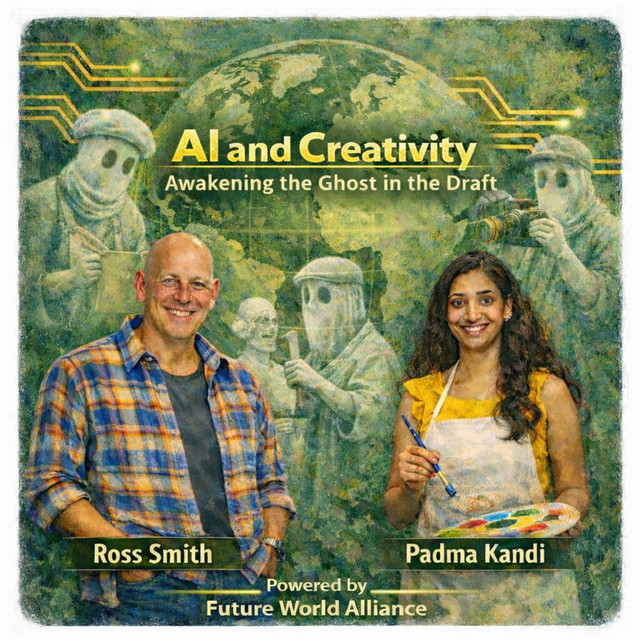
Awakening the Ghost in the Draft
What your discarded first version knows that your finished piece has forgotten.
Show notes
What your discarded first version knows that your finished piece has forgotten.
A TECHNIQUE FOR WRITERS, PAINTERS & MUSICIANS: READY TO USE TODAY
There is a particular sting that every creative person knows, the moment you watch someone else’s version of your idea get the standing ovation, the promotion, the green light. A dancer loses an audition not to someone better, but to someone who felt like a mirror. A writer sees their shelved concept on a bestseller list under another name. A designer watches a pitch they abandoned get funded in someone else’s hands. The pain isn’t jealousy, exactly. It’s the haunting suspicion that the gap between you and them wasn’t talent, it was something quieter and more correctable. Something in how the idea was carried, how it was refined, how much of the original fire survived the editing process.
What if the answer was hiding in your own earlier work all along? The technique that follows treats your first draft not as a failure to be discarded, but as a witness, one with a long memory and no incentive to flatter you. By giving that early version a voice and asking it to interrogate your current work, you create a creative feedback loop that no outside editor can replicate. Your rough first attempt knew things your polished final version has quietly forgotten: the urgency that started it, the risk you were willing to take before you knew who was watching, the specific emotional truth you sanded off in the name of professionalism. This method puts that ghost back in the room, and lets it ask the questions that could close the gap between good and the version that actually lands.
Every creative work has a body count. The abandoned drafts, the painted-over layers, the chord progressions you muted at 2am, they don’t disappear. They become the foundation. And sometimes, they become ghosts.
Here’s what nobody tells you: your first version knew something your final version has since decided to forget. The rawness was a clue. The wrongness was information. The thing that made you cringe was often the thing that was most you.
The technique I want to teach you today uses AI not to create, but to excavate, to drag that ghost back into the room and make it talk.
The Séance Method
Pull up any piece you’ve substantially revised. A story you rewrote. A canvas you painted over. A song arrangement you overhauled. Now open a conversation with Claude, ChatGPT, Copilot, Gemini, or any capable AI, and try this:
Describe your original version, as much as you remember, in plain language. Don’t be precious about it. Then describe your current version. If you have an original file, uploaded it. Do the same for the current or final version you have now.
Then type something like:
“You, my first draft: You know what you were trying to do. Interview my final piece. Be curious. Be a little hurt. Ask it what it lost when it became what it is now.”
Then read what comes back. Slowly.
Draft One: Speaking
“You used to start with the argument in the kitchen. The reader didn’t know whose fault it was yet. Remember? There was real heat in that room. Where did it go?”
Final Draft: Answering
“I moved it to chapter three. The editor said the opening was too abrasive. I opened on the morning light instead. The birdsong.”
Draft One: Speaking
“The birdsong. Right. And did you ever wonder if that’s why readers say they can’t quite connect with her? That they find her cold? You protected her. But you protected yourself more.”
That exchange is not fiction. That is the kind of thing that comes back. And when it does, you will feel it land somewhere specific in your chest, because it’s not the AI speaking. It’s you, finally saying what you already knew.
“The AI is not the artist. It’s the medium. You are both the ghost and the haunted.”
For Painters & Musicians: A Different Séance
If your work is visual or sonic, the interview flips. You can’t show the AI your canvas, but you can describe both versions in detail. The AI then plays interviewer, asking you to justify the changes you made. Try this prompt:
“Ask me, as a curious but skeptical art critic, why I made each of these changes. Press me when my answers sound defensive. I should feel mildly uncomfortable.”
The slight discomfort is the point. Comfort in self-assessment is where lazy work hides. The moment you start to feel vaguely exposed by an AI’s follow-up question, “But why gold? You said the original was silver. What were you running from?”, is the moment you’re actually doing creative analysis, not just justification.
Try It Now: Four Prompts to Copy Directly
For writers”You are my first draft of [piece]. Interview my current version. Ask what it sacrificed to be liked. Don’t let it off easy.”
For painters”I changed X to Y in my painting. Interview me about that decision. Be a skeptical critic. Ask follow-up questions when my answers sound like excuses.”
For musicians”My original arrangement had [describe it]. I changed it to [describe final]. Play the role of the original version. Ask the final version what it traded away for polish.”
For anyone”You are everything I cut from this piece. Speak as one voice. What were you trying to say that I wasn’t ready to let through?”
The Full Practice: Step by Step
Choose a piece with history. It needs at least one major revision, something meaningfully different, not just a typo fix.
Write two descriptions. One for the original, one for the current. Be specific. Include what the emotional register was, what the central gesture or image was, what you were trying to do.
Set the AI’s role clearly. “You are Draft One” or “You are the interviewer.” Give it a personality, curious, wounded, skeptical. Vague setups get vague answers.
Run the interview for at least 6 exchanges. The first two are warm-up. The real material comes when the AI starts pressing on something and you feel resistance rising in you.
Write down the one question that stung. Just one. Then spend 20 minutes responding to it in your journal, not in the chat. That’s your next creative session’s north star.
Here is an example prompt with 2 versions of a whitepaper.
These two documents have come to life. Draft1.docx is the interviewer. He is curious, skeptical and a little hurt by being revised. Current1.docx is an updated version and is the one being interviewed. They are proud, but analytical and open to ideas. have Draft1 interview for 6 questions but have Current1 answer each one at a time and the interviewer will base the next question on the previous answers. Upon the conclusion of the interview questions, write a summary and list of recommendations for the author.
What You’re Actually Doing
This technique works because revision is rarely purely rational. We don’t just make things better, we also make things safer, more palatable, more polished in ways that sand off the fingerprints. The ghost of the first draft remembers the fingerprints.
AI has no ego investment in your comfort. It will ask the question your trusted readers are too kind to ask, your workshop peers too politic to raise, and your own inner voice too exhausted to formulate at 11pm after the fifteenth revision.
You’re not outsourcing your creativity. You’re giving your own subconscious a voice it doesn’t usually get, one that arrives from outside yourself, in the disorienting costume of a machine, saying something true.
The ghost has been waiting. Let it speak.
Pro Tip 1: When you’re describing these versions, don’t just talk about the what, talk about the why. Tell the AI what your “central gesture” or emotional register was in the beginning so the ghost can hold the new version accountable. An example prompt might be, “In my original version of this painting, the central gesture was an aggressive, jagged stroke meant to represent a cry for help. Now it is a smooth gradient. As the original version, interview the current version about why it abandoned that raw emotion for aesthetic safety.”
Pro Tip 2: If the conversation starts getting too polite, “prime the pump” by giving the AI a specific secret that only the first version knows. Maybe it’s about a specific chord progression you altered because you were afraid it sounded too much like your influences. An example prompt might be “You are the original demo recording of this song. You alone know that the bridge was built around a finger-picked guitar pattern I wrote the night my father went into the hospital, a pattern I later replaced with a clean, produced synth line because I thought it sounded more ‘professional.’ Use that knowledge to press the final version on why it traded that raw, specific grief for something a general audience would find easier to sit with.”
Pro Tip 3: For painters. Use the “Skeptical Art Critic” mode. Tell the AI to specifically press you on the layers you painted over. If it asks, “But why gold? You said the original was silver. What were you running from?”, don’t flinch! That slight discomfort is where the real creative analysis happens. Example? “I changed the original silver background to a polished gold. Act as a skeptical art critic and interview me about this change. Press me when my answers sound like I’m just making excuses or playing it safe, and make me justify why the silver had to die.”
Pro Tip 4 is about stamina: Run the interview for at least six exchanges. The first few are just warm-ups; the real material comes when you feel resistance rising in you during the later questions. The example is “Let’s begin a 6-question interview where you are my first draft and I am the final version. For the first two questions, focus on the setting, but for the final four, I want you to get increasingly skeptical and wounded about the emotional heart I cut out. Wait for the answer to each one and evolve the questioning based on each answer.”
Pro Tip 5 for the multi-disciplinary folks: Have the ghost version interview you, the artist, specifically about what was lost in the transition. Ask it to be curious about those muted chords or that hidden sketch beneath the oil paint. It forces you to justify your choices to the “soul” of the original idea. Example prompt is “I am the artist, and you are the original chord progression I muted because I thought it sounded too much like Radiohead. Interview me about that decision. Don’t let me off easy; ask me what the song traded away in exchange for that ‘originality’ and polish.”
Pro Tip 6: Once you finish, write down the one question that “stung” the most. Don’t keep talking to the AI; take that question to your physical journal for 20 minutes to find your next creative “north star”. The prompt example is “Based on our interview so far, what is the one question you have asked that made me sound the most defensive or uncomfortable? Identify that single ‘sting’ and explain why that specific point represents the ghost of what I was originally trying to say.”
Pro Tip 7: Close the loop by asking the AI to step out of character and become a “performance critic”. Ask it to write up a summary of the entire interview along with a list of top recommendations for you to pursue next. It’s like getting a post-game analysis of your own creative subconscious. The example prompt is “The interview is now concluded. Step out of your role as the ghost and act as a professional performance critic. Provide a summary of our discussion and list three specific, actionable recommendations for how I can reintegrate the ‘fingerprints’ of my first draft into this final piece.”
Bonus Points: Add a 3rd iteration of your work into the conversation and use a “Trees of Thought” prompt technique to invite the 3 of them to have a panel discussion amongst themselves and come to agreement on what needs to change in the current version.
Latest episodes
 July 28, 2026 · 7 minThe Gap that won’t CloseWhy AI Might Be the Best Tool We’ve Ever Built for Staying Curious
 July 23, 2026 · 5 minWhat J.R.R. Tolkien Can Teach Us About AI and CreativityOverview
 July 15, 2026 · 6 minSteering Away From the Middle: What the Great Creators Teach Us About Using AIIn 1965, driving his family toward Acapulco for a holiday, Gabriel García Márquez is said to have heard the opening voice of One Hundred Years of Solitude…